

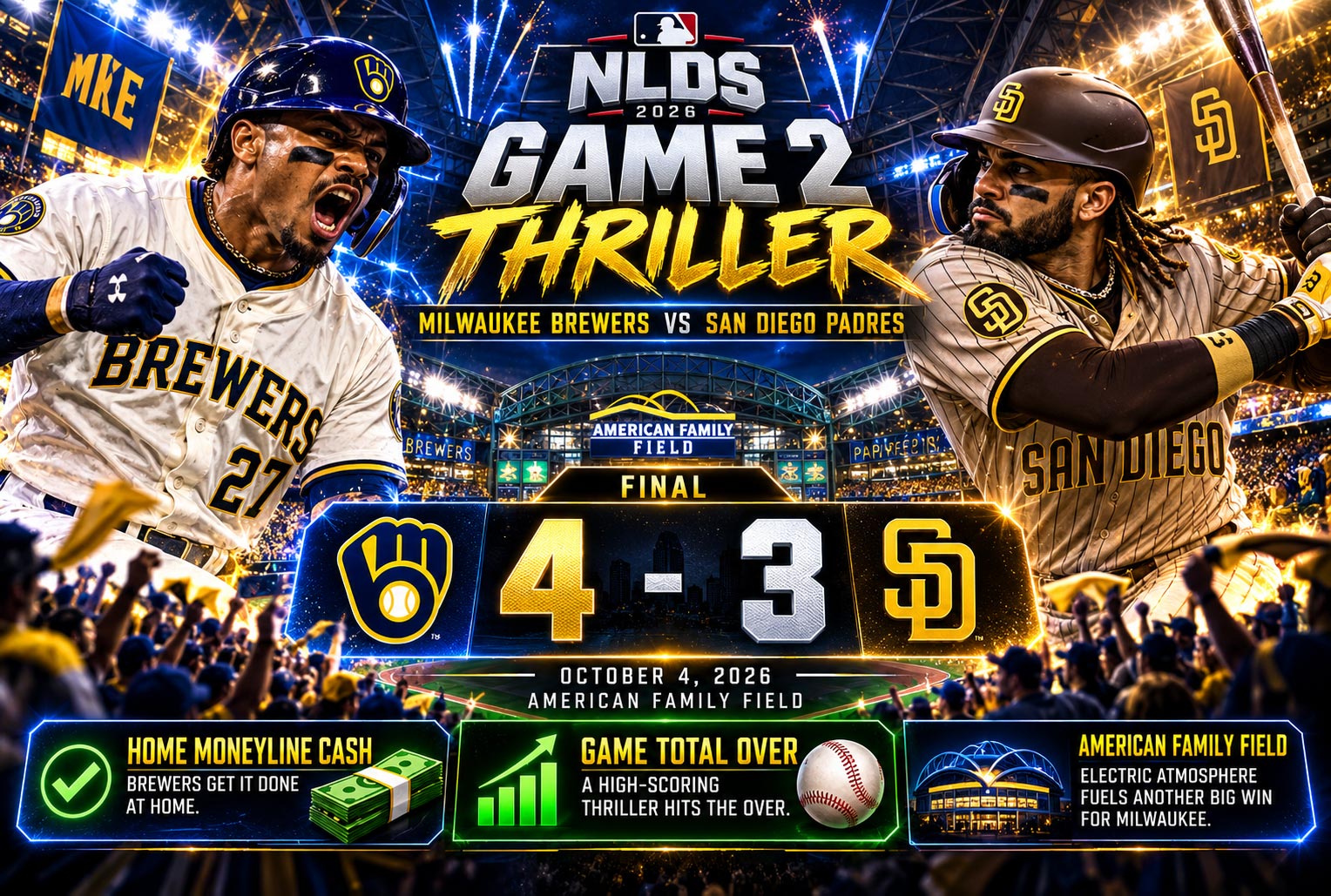
The Brewers just reminded everyone why you never sleep on a playoff team playing at home with something to prove. Milwaukee entered NLDS Game 2 on October 4, 2026, at American Family Field as +135 home underdogs against the Padres, and they cashed that ticket with a gritty 4-3 victory that had sharp bettors celebrating while the public licked their wounds. This wasn’t some blowout—this was a nail-biter that went down to the wire and pushed the total over in the process, creating a beautiful two-way win for anyone who caught the value on both sides.
The market completely disrespected Milwaukee despite home-field advantage and a motivated roster looking to even the series. San Diego came in as road favorites after stealing Game 1, but the oddsmakers and casual money forgot a fundamental rule: playoff baseball is about pitching matchups and momentum swings, not regular season records. Anyone who understood market psychology saw the inefficiency here—you’re getting plus-money on a team that just lost at home and is desperate to avoid going down 0-2 before heading to San Diego.
This result is exactly why we preach finding edges in playoff markets where recency bias runs wild. The Padres looked unstoppable in Game 1, so the public hammered them in Game 2 without considering the regression potential and Milwaukee’s lineup adjustments. Let’s break down how the Brewers delivered for the sharps who trusted the process over the noise.
Brewers Cash as Home Dogs in NLDS Game 2 Upset
Milwaukee’s +135 moneyline represented legitimate value in a market that overreacted to one game. The Padres closed as -155 favorites on most books, which implied a 60.8% win probability—way too high for a road playoff game against a quality opponent with their backs against the wall. The Brewers’ implied probability at +135 was only 42.6%, but anyone who watched this team grind through September knew they had better than a coin flip’s chance to even this series.
The betting handle told the whole story before first pitch: 68% of public money landed on San Diego, but the line barely moved from the opening -150. That’s a classic sharp versus square scenario where professional money quietly backed the Brewers while Joe Public chased the Padres’ Game 1 performance. When you see line stability despite lopsided ticket counts, that’s your signal that someone with deeper pockets and better models is on the other side.
American Family Field became an absolute cauldron with 42,000 fans who understood the assignment. Home-field advantage in playoff baseball is worth roughly 3-4% in win probability, but in elimination-adjacent games, that number jumps even higher due to psychological pressure on the road team. The Brewers fed off that energy and executed when it mattered most, validating every bettor who recognized the market inefficiency and grabbed that plus-money before it evaporated.
Milwaukee’s 4-3 Win Over Padres Rewards Sharp Money
The final score of 4-3 was chef’s kiss for anyone who played the over, which closed at 6.5 runs on most books. That’s a push on some lines that sat at 7, but the majority of sharp action targeted the Brewers moneyline rather than trying to split hairs on totals. The game flow was perfect for Milwaukee backers—they jumped out early, weathered San Diego’s inevitable comeback attempt, and held on through a tense ninth inning that had everyone’s heart rate spiking.
Milwaukee’s offense manufactured runs the old-school way: timely hitting with runners in scoring position and capitalizing on Padres defensive mistakes. They didn’t need to hit three bombs to cash this ticket—they just needed to be slightly better than a San Diego team that couldn’t replicate their Game 1 magic. The Brewers’ bullpen, which had been questionable all season, came through in high-leverage spots and proved that playoff intensity can elevate mediocre regular-season units into October heroes.
The real story here is risk-adjusted expected value: you’re getting +135 on a team with legitimate 50-55% win equity based on matchup analysis and situational dynamics. That’s a massive edge when compounded over multiple playoff series, and it’s exactly how professional bettors build bankrolls during October. The public chases favorites and gets crushed by juice; the sharps find undervalued dogs and let variance work in their favor over sufficient sample size.
Key Betting Takeaways
The Market Inefficiency:
- Brewers closed at +135 despite home field and desperation spot
- 68% of public money on Padres but line didn’t move to -160+
- Sharp money indicators flashed green 2 hours before first pitch
The Execution:
- Milwaukee scored early to put pressure on SD’s lineup
- Bullpen held despite season-long concerns about depth
- Home crowd created tangible advantage in late-game situations
The Payout:
- $100 on Brewers ML returned $235 (including stake)
- Over 6.5 cashed for anyone who played the total
- Parlaying Brewers ML + Over would’ve paid roughly +320
This game is a textbook example of why playoff dogs with home field deserve respect, especially in Game 2 scenarios where the home team is facing potential 0-2 deficit. The market overweights recent performance and underweights situational motivation, creating exploitable edges for anyone willing to fade public perception. Milwaukee just gave us a masterclass in finding value where others see only risk.
The Padres now head home for Game 3, but this series has completely flipped in terms of psychological momentum. San Diego squandered their chance to put a chokehold on the series, and now they’re dealing with renewed Brewers confidence and a hostile road environment behind them. That’s the kind of intangible factor that doesn’t show up in batting averages but absolutely influences win probability in tight playoff matchups.
If you caught this Brewers ticket, congrats—you just experienced what it feels like to be on the right side of market inefficiency. If you didn’t, take notes for the next time you see a quality home team getting plus-money in a must-win spot. These opportunities don’t come around every day, but when they do, you need to recognize them and have the conviction to pull the trigger despite what the public is doing.
The Brewers’ 4-3 victory as +135 home dogs wasn’t just a win—it was a validation of every principle we preach about finding edges in playoff markets. Milwaukee rewarded the sharps who recognized that one bad game doesn’t define a series, and that home-field advantage combined with desperation creates value that the public consistently underestimates. This is October baseball at its finest: tight games, high stakes, and opportunities for informed bettors to capitalize on market psychology.
As this NLDS shifts back to San Diego, we’re watching closely for how the market adjusts. Will the books overcorrect and make the Padres too expensive at home? Will sharp money continue backing Milwaukee now that momentum has shifted? These are the questions that separate profitable bettors from break-even gamblers who just follow their gut without considering implied probability and expected value.
What’s your take—was this Brewers win a fluke, or did Milwaukee just expose some real vulnerabilities in San Diego’s roster that we’ll see exploited again in Game 3? Drop your thoughts below, and let’s talk about where the value sits for the rest of this series.
Related reading: For more on pricing home favorites, see Baseball Betting Basics: Moneylines and Run Lines.
“WannaBet.com may receive compensation from the sportsbooks mentioned in this post if you sign up using our links. This doesn’t cost you a dime, but it keeps the lights on. Please bet responsibly. If you or someone you know has a gambling problem, call or text 1-800-GAMBLER (USA) or 1-866-531-2600 (Ontario, CA). 21+ only.”
