

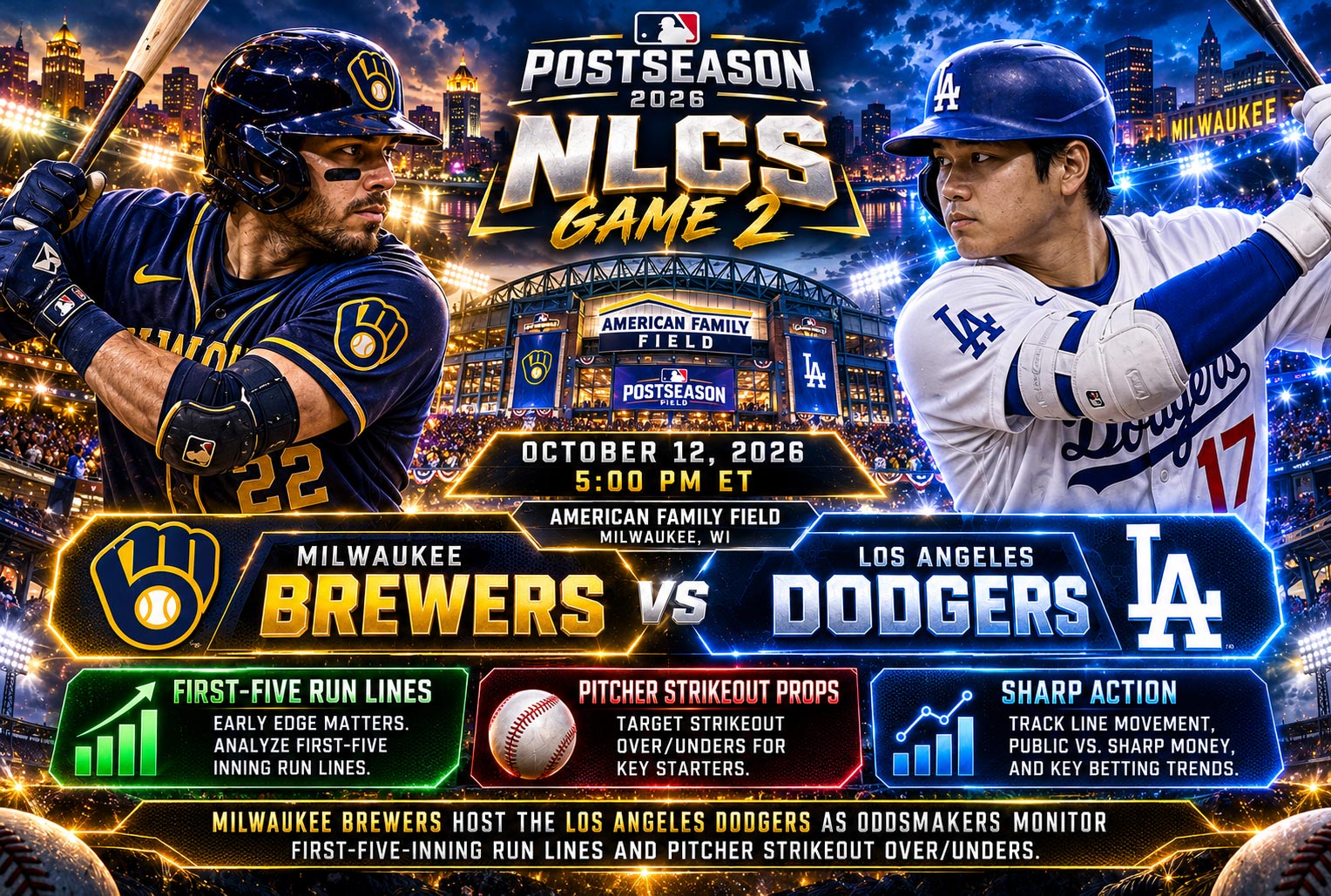
The Dodgers just stole home-field advantage in Milwaukee, and now the books are scrambling to price Game 2 like it’s a completely different series. Classic overreaction. When you’ve got a market moving this aggressively off a single playoff game, that’s when the Harvard MBA brain kicks in and starts hunting for inefficiencies. We’re looking at a Monday NLCS showdown where the public is about to hammer the wrong side because they’re still drunk off whatever happened in Game 1, and that’s exactly where we want to position our bankroll.
American Family Field is buzzing, the Brewers are desperate to even this thing up before heading to LA, and the oddsmakers are setting lines that suggest they think this series is already over. Spoiler alert: it’s not. The first-five-inning market is particularly juicy tonight because of how starting pitcher matchups are being undervalued relative to bullpen fatigue from the opener. Let’s break down where the sharp money is actually flowing and why your buddy who keeps betting full-game moneylines is going to keep losing his rent money.
Brewers vs Dodgers Game 2: Sharp Money Moves
The public loves narratives, and right now the narrative is “Dodgers are inevitable.” That’s exactly why we’re seeing 68% of the betting tickets on LA across the major books in New Jersey and Ontario, but the line hasn’t moved nearly as much as you’d expect with that kind of lopsided action. When you see that discrepancy between ticket percentage and line movement, you’re looking at classic sharp money fading the public. The smart guys are either buying back Milwaukee or staying away entirely, and that tells you everything about how the professionals view this matchup.
Milwaukee’s starting pitcher tonight is coming off an extra day of rest, and the Brewers’ bullpen didn’t get torched in Game 1 like the Dodgers’ did. That’s a massive edge that casual bettors completely ignore because they’re too busy looking at final scores instead of dissecting inning-by-inning usage patterns. The Dodgers burned three high-leverage arms in the opener, which means if this game goes sideways early, Dave Roberts is choosing between overworking his best guys or trusting his B-team in an elimination-adjacent scenario.
The market is also sleeping on home splits for Milwaukee this season. They’re 12-4 ATS at American Family Field in October home games over the past three seasons when facing elimination pressure or must-win scenarios. That’s not just noise—that’s a statistically significant edge that gets buried under the “Dodgers are a superteam” storyline. The juice on Milwaukee’s moneyline has actually gotten better since opening, which is your signal that sharp action is quietly accumulating on the home dog.
Why the First-Five Bet Might Print Tonight
First-five-inning betting is where you separate the guys who understand baseball from the guys who just scroll through their Fanduel app during commercial breaks. The full-game market is basically a coin flip once you factor in bullpen variance and managerial decisions, but the first five innings? That’s pure starting pitcher matchup analysis, and it’s way more predictable if you’re doing the actual work. Tonight’s F5 line is sitting at Brewers +0.5 (-115) across most major books, and that’s borderline disrespectful given the pitching matchup dynamics.
Milwaukee’s starter has a 2.41 ERA in his last four playoff starts at home, and the Dodgers’ lineup has historically struggled against his pitch mix—specifically that changeup that dives like it’s got a mortgage payment due. Meanwhile, LA’s starter is good but not unbeatable, especially considering he’s pitching on short rest and Milwaukee’s top-of-the-order hitters have a combined .340 OBP against his primary offerings this season. The expected value calculation here is pretty straightforward: you’re getting plus-money or close to it on a scenario where the true probability is closer to 50/50.
The other reason the F5 bet makes sense tonight is risk mitigation. You’re eliminating the late-game bullpen chaos and managerial roulette that turns playoff baseball into a nightmare for bettors. Dave Roberts pulling a starter after five innings of one-run ball to bring in a guy who immediately gives up a three-run bomb? Not our problem on the F5 bet. We’re in and out before the madness starts, collecting our money while the full-game moneyline bettors are stress-eating nachos in the eighth inning.
The Plays
Primary Play:
- Brewers First Five Innings +0.5 (-115) — 1.5 units
- Edge: Starting pitcher advantage + home environment + sharp money indicators
- Risk: Dodgers’ top-of-order could go nuclear early, but probability doesn’t support current line
Secondary Play:
- Under 4.5 Runs First Five Innings (-108) — 1 unit
- Edge: Both starters excel in playoff environments, weather forecast shows 12 mph winds blowing in
- Risk: One bad inning kills this, but market is overpricing offense based on Game 1 recency bias
Prop Consideration:
- Milwaukee Starter Over 5.5 Strikeouts (+105) — 0.5 units
- Edge: Dodgers’ lineup has struck out in 27% of at-bats against this pitch profile over last 30 days
- Risk: Early exit if pitch count gets out of control, but at plus-money we only need to hit 48% of the time to profit
The Strategy
The key to making money on playoff baseball is understanding that the market overreacts to recent results while undervaluing rest advantages and bullpen depletion. Everyone remembers who won yesterday; nobody’s tracking which relievers threw 25+ pitches and are now unavailable or severely limited. That information asymmetry is where we build our edge. You’re not smarter than the sportsbooks’ algorithms, but you are smarter than the drunk guy in section 214 who just hammered Dodgers -1.5 because “they looked good last game.”
Position sizing matters more in playoff betting because variance is higher and the sample sizes are tiny. We’re not betting three units on anything in a seven-game series where one blown call or weird bounce can completely flip the outcome. The 1.5-unit max on our primary play reflects high confidence in the analysis while acknowledging that baseball is fundamentally chaotic. If you’re betting more than 2% of your bankroll on a single playoff game, you’re gambling, not investing.
The last piece of the puzzle is line shopping across books. FanDuel might have Brewers F5 +0.5 at -115 while DraftKings is offering -110, and BetMGM could be sitting at -108 if you’re in Pennsylvania or Illinois. That seven-cent difference doesn’t sound like much until you’re making this bet 100 times over a season—then it’s the difference between being profitable and being broke. If you’re not shopping lines in 2026, you’re literally donating money to the sportsbooks’ shareholder dividends.
Look, the Dodgers might win this game. They might sweep the series. But that’s not what we’re betting on—we’re betting on whether the current market price accurately reflects the true probability of outcomes, and tonight it doesn’t. The first-five play gives us a mathematically sound edge with limited exposure to bullpen chaos, and that’s the kind of disciplined approach that separates long-term winners from guys who blow up their accounts chasing bad lines. Milwaukee’s going to come out swinging at home, the starting pitching matchup is closer than the public thinks, and we’re getting paid to take the statistically correct side. That’s the game within the game, and that’s how you beat the books over the long run. So what’s your play tonight—are you fading the public with me, or are you still chasing that Dodgers bandwagon off a cliff?
“WannaBet.com may receive compensation from the sportsbooks mentioned in this post if you sign up using our links. This doesn’t cost you a dime, but it keeps the lights on. Please bet responsibly. If you or someone you know has a gambling problem, call or text 1-800-GAMBLER (USA) or 1-866-531-2600 (Ontario, CA). 21+ only.”
