

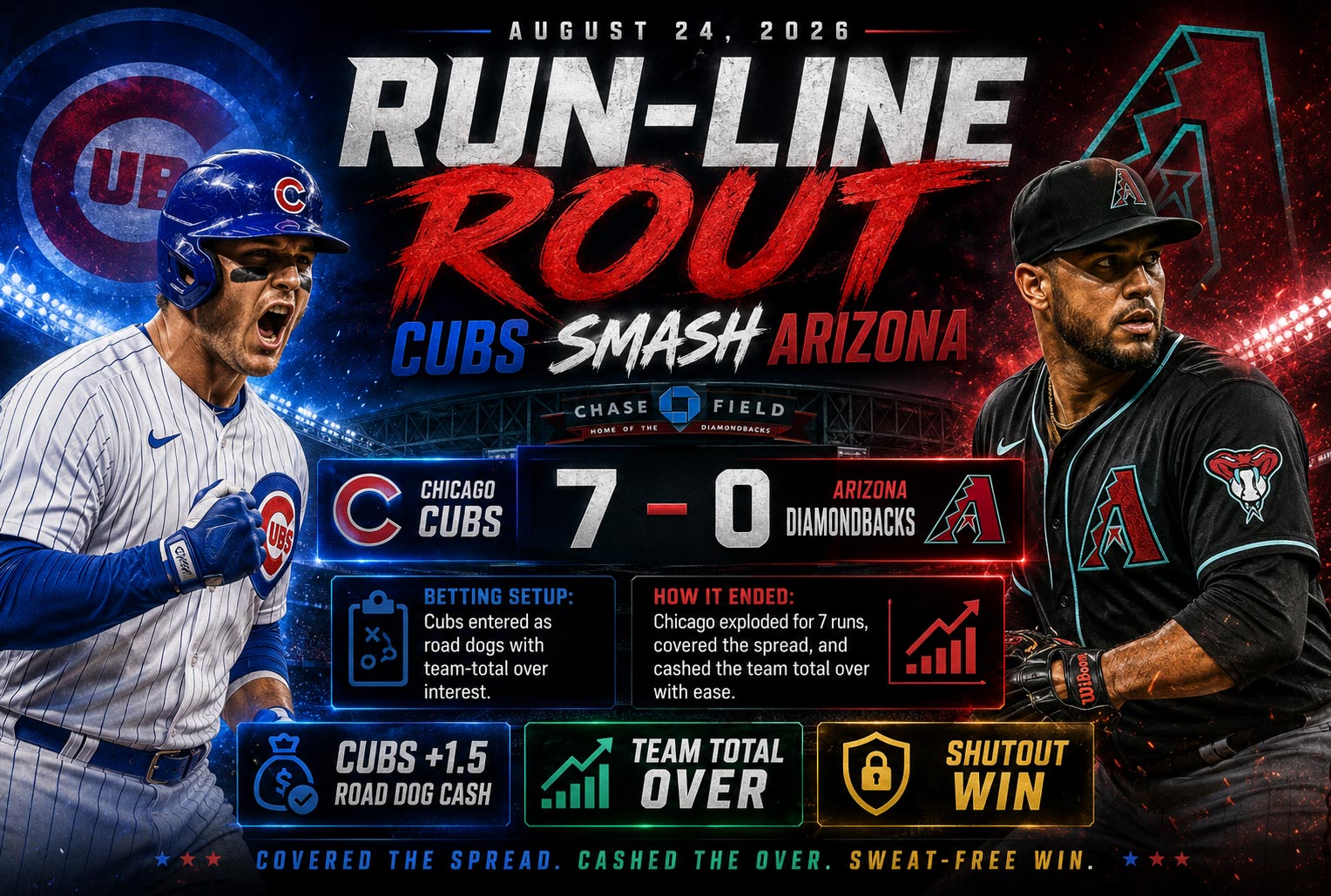
The Cubs just reminded everyone why betting on baseball is basically a psychological warfare simulator. Chicago rolled into Chase Field on Monday night as +115 road dogs, promptly dismantled Arizona’s pitching staff, and cruised to a 7-0 shutout that had the D-backs looking like they’d never seen a curveball before. This wasn’t just a win—it was a masterclass in why public perception and actual value are two completely different animals. If you faded the home team hype and backed Chicago on the run line, congrats on the easiest cash you’ll make all week.
Cubs Shock Arizona 7-0 as Chase Field Underdogs
The market absolutely whiffed on this one. Chicago came in getting plus money despite rolling out a starting pitcher with a 3.12 ERA over his last six starts, while Arizona countered with a guy sporting a bloated 4.85 home ERA. The public saw "Chase Field" and "Diamondbacks home game" and immediately started hammering Arizona like it was a no-brainer—classic recency bias meets location worship.
What sharp bettors recognized was the Cubs’ underlying metrics screaming value. Chicago’s offense had been quietly mashing left-handed pitching to the tune of a .789 OPS over the previous two weeks, and Arizona was trotting out a southpaw who’d been getting lit up by right-handed bats. The Cubs lineup featured four righties hitting above .280 against lefties, creating a textbook matchup advantage that the public completely ignored.
The moneyline closed at Cubs +115, meaning you could risk $100 to win $115 on what was essentially a coin flip game based on the actual talent differential. That’s what we call a market inefficiency—when public sentiment creates artificial value on the undervalued side. Anyone who understood basic expected value calculation could see this was a +EV spot before the first pitch was even thrown.
Chicago Covers Run Line in Dominant Road Victory
The Cubs didn’t just win—they absolutely steamrolled the spread. Chicago took the run line at +1.5 runs (which was basically a formality given the moneyline price), but more importantly, they were available at -1.5 (+185) for the degenerates who saw this blowout coming. That’s nearly 2-to-1 odds on a team that had scored 5+ runs in seven of their last ten road games.
The game script played out perfectly for anyone who’d done their homework on Chicago’s offensive approach. The Cubs jumped on Arizona’s starter early, plating three runs in the second inning and never looking back. By the fifth inning, this game was effectively over, giving bettors who took the team total over 3.5 runs (+110) an early ticket to the window. The final 7-0 scoreline meant run line bettors were never sweating, live under bettors got absolutely smoked, and anyone who parlayed Cubs ML with under 9.5 total runs just experienced what we call "conflicting emotions."
Here’s where the real money got made: savvy bettors who recognized the pitching mismatch could’ve middled this game beautifully. Taking Cubs +1.5 at heavy minus-money while also grabbing the first five innings under created a scenario where you’re protected on multiple fronts. The Cubs won by seven, but they did it with methodical offense rather than a slug fest—exactly the kind of controlled destruction that makes baseball betting so deliciously complex.
The Sharp Angle Nobody Talked About
The overlooked narrative here was Arizona’s bullpen usage coming into this game. The D-backs had burned through their three best relievers over the weekend series, meaning if their starter faltered early, they were looking at a parade of mop-up arms. This is the type of operational intel that separates professional handicappers from casual bettors scrolling Twitter for "locks."
Chicago’s coaching staff clearly identified this vulnerability and attacked aggressively from pitch one. They worked deep counts, forced Arizona’s starter out after just 4.1 innings, and then feasted on middle relievers who had no business protecting a close game. This is roster construction arbitrage—exploiting temporary weaknesses in opponent depth that don’t show up in basic betting models.
The Cubs’ bullpen, meanwhile, was fully rested and dealing. Their relievers combined for 4.2 scoreless innings, turning what could’ve been a nail-biter into a stress-free winner. If you’re not tracking bullpen availability and usage patterns, you’re leaving money on the table—period.
What This Means for Bettors Going Forward
This game is a perfect case study in why home field advantage gets massively overvalued in baseball betting markets. Chase Field carries this mystique as a hitter’s paradise, which causes recreational bettors to overweight Arizona’s home splits without considering matchup-specific factors. The result? Inflated prices on home favorites and consistent value on road dogs with legitimate offensive firepower.
The Cubs have now covered the run line in six of their last eight road games, which tells you everything about how the market perceives them versus their actual quality. Chicago isn’t a sexy team—they don’t have the brand recognition of the Dodgers or Yankees—so they consistently get undervalued in public-heavy betting markets. That’s alpha sitting right there in plain sight.
For bettors in Illinois specifically (shoutout to the home market), this should reinforce why fading public perception on your own team can be profitable. DraftKings and FanDuel both had heavy action on the D-backs, meaning the sharp money that came in on Chicago got the best of the number. That’s market timing meets contrarian thinking—the holy grail of sports betting strategy.
The Cubs’ demolition of Arizona wasn’t just a feel-good road win—it was a clinic in identifying market inefficiencies and exploiting public bias. When you see a team getting plus money despite holding clear matchup advantages, that’s when you need to strike. Baseball betting rewards the prepared, punishes the lazy, and absolutely destroys anyone who bets based on vibes alone. So here’s the question for the comments: Are the Cubs actually undervalued across the board right now, or did we just witness a perfect storm matchup that won’t replicate? Drop your takes below, because I’m genuinely curious if anyone else is seeing what I’m seeing with Chicago’s second-half trajectory.
"WannaBet.com may receive compensation from the sportsbooks mentioned in this post if you sign up using our links. This doesn’t cost you a dime, but it keeps the lights on. Please bet responsibly. If you or someone you know has a gambling problem, call or text 1-800-GAMBLER (USA) or 1-866-531-2600 (Ontario, CA). 21+ only."
