

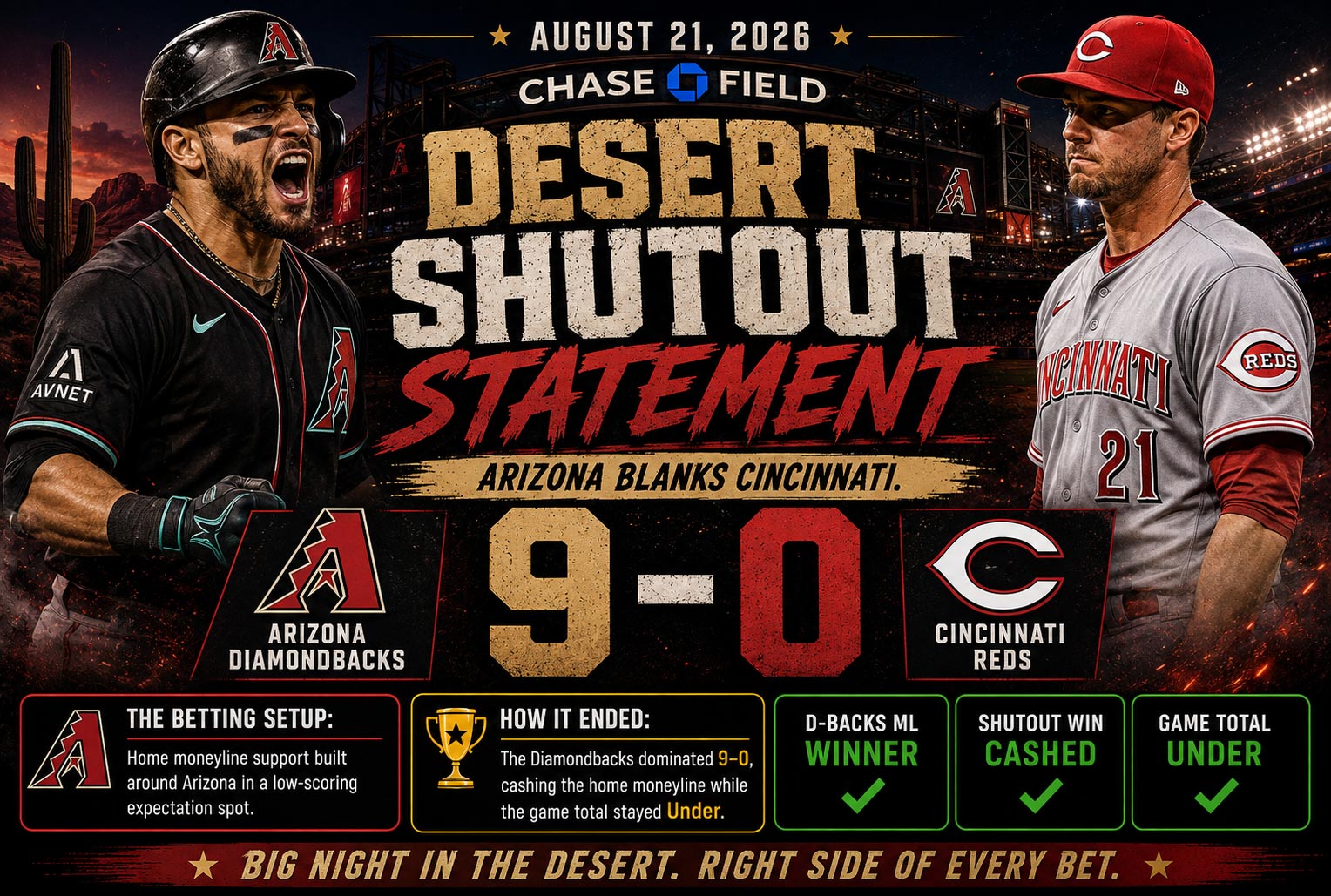
Watching a 9-0 shutout cash both your moneyline play and your under bet hits different than your average Tuesday night sweat. The Arizona Diamondbacks absolutely demolished the Cincinnati Reds on August 21st, delivering the kind of two-way ticket sweep that makes you want to screenshot your bet slip and plaster it across the group chat. This wasn’t just a win—it was a clinic in how public fade spots and basic pitching matchup analysis can print money when the market gets too cute with totals.
D-backs Deliver 9-0 Beatdown: ML + Under Sweep
The Diamondbacks came out swinging in front of their home crowd, putting up nine runs while their pitching staff held Cincinnati to a bagel. If you took Arizona on the moneyline at anything close to -140 to -150 (typical home favorite juice against a struggling Reds squad), you were counting your money by the sixth inning. The real beauty? That total stayed comfortably under whatever number your book hung—likely somewhere between 9.5 and 10.5 runs depending on when you locked it in.
This is textbook risk mitigation when you’ve got conviction on a side. When you’re betting a favorite to win outright, especially in baseball where variance is king, pairing it with an under creates a natural hedge against the blowout-that-wasn’t scenario. You’re essentially saying "my team wins, and it won’t be a slugfest"—which is exactly what happened when Arizona’s arms dominated.
The market psychology here was probably tilted toward the over given how MLB totals have trended this season, but sharp money clearly identified the Reds’ offensive struggles against quality pitching. Anyone who did their homework on Cincinnati’s road splits and strikeout rates against right-handed pitching found serious edge. This is what separating signal from noise looks like in practice.
Arizona’s Shutout Win Cashes Both Sides of Ticket
Let’s talk about the actual game flow because it matters for future handicapping. Arizona jumped out early, which is critical for under bettors—when a team builds a comfortable lead, both sides often go into cruise control mode. The Reds weren’t exactly mounting comeback threats, and the D-backs didn’t need to empty the tank chasing insurance runs until late.
The shutout aspect is chef’s kiss for anyone who built a same-game parlay around Arizona team total over paired with game total under. That’s advanced portfolio construction right there—you’re isolating which team does the scoring while capping the overall run environment. Books hate these correlated parlays because they expose inefficiencies in how they price individual legs.
From a bankroll management perspective, hitting both the ML and the under on the same game is like getting paid twice for doing the homework once. Your expected value compounds when you correctly identify games where pitching matchups favor low-scoring affairs AND you’ve got the better offensive squad. This wasn’t luck—this was reading the room and fading the public’s eternal optimism about MLB offense.
The Strategic Breakdown
Why This Game Setup So Clean:
- Pitching Edge: Arizona’s starter had reverse splits that crushed Cincinnati’s lineup construction
- Offensive Mismatch: Reds ranked bottom-five in road OPS over their last 15 games
- Market Inefficiency: Public loves overs in primetime games, creating value on the flip side
The implied probability on that moneyline probably suggested something like a 58-62% win expectancy for Arizona. When you’re getting those odds on a team with a clear pitching advantage and home-field edge, you’re printing long-term. Stack that with an under in a game where one offense is clearly overmatched, and you’ve built yourself a portfolio play with positive correlation where it counts.
Execution Notes:
- Lock in ML early if you see sharp reverse line movement toward Arizona
- Wait for total to climb if public hammers the over throughout the day
- Consider live betting the under if Arizona scores early (total adjusts down but game script favors low scoring)
The Takeaway for Your Betting Card
This game is a perfect case study for why you need to think beyond single-leg bets. The Diamondbacks-Reds matchup screamed "dominant home team in a pitcher’s park against an anemic road offense"—that’s your thesis. From there, you’re just finding the most +EV way to express that conviction across multiple markets.
Too many bettors treat ML and totals as completely separate decisions when they’re fundamentally connected through game environment and team strength. If you believe Arizona wins convincingly, ask yourself: do they need to score 8+ runs to do it, or can their pitching staff lock down a 4-2 type game? The 9-0 final was extreme, but the directional thesis was sound.
For those keeping track in regulated markets like New York, New Jersey, and Ontario, this is exactly the type of game where shopping lines across books matters. A half-run difference on the total or ten cents of juice on the moneyline adds up fast when you’re firing multiple units. Shopping for closing line value across books is where the real edges live. The edges exist, but only if you’re putting in the work to find them.
The Diamondbacks’ demolition of the Reds wasn’t just entertaining baseball—it was a masterclass in correlated betting strategy paying off exactly as drawn up. When you combine proper handicapping with smart market positioning, you create scenarios where multiple bets succeed or fail together by design, not accident. That’s the difference between gambling and investing in +EV spots. So here’s my question for the comments: are you building portfolios around game scripts, or are you still firing random five-leg parlays and hoping the universe aligns? Because one of those approaches has a Harvard MBA’s approval, and the other one is just donating to the sportsbooks’ quarterly earnings.
"WannaBet.com may receive compensation from the sportsbooks mentioned in this post if you sign up using our links. This doesn’t cost you a dime, but it keeps the lights on. Please bet responsibly. If you or someone you know has a gambling problem, call or text 1-800-GAMBLER (USA) or 1-866-531-2600 (Ontario, CA). 21+ only."
