

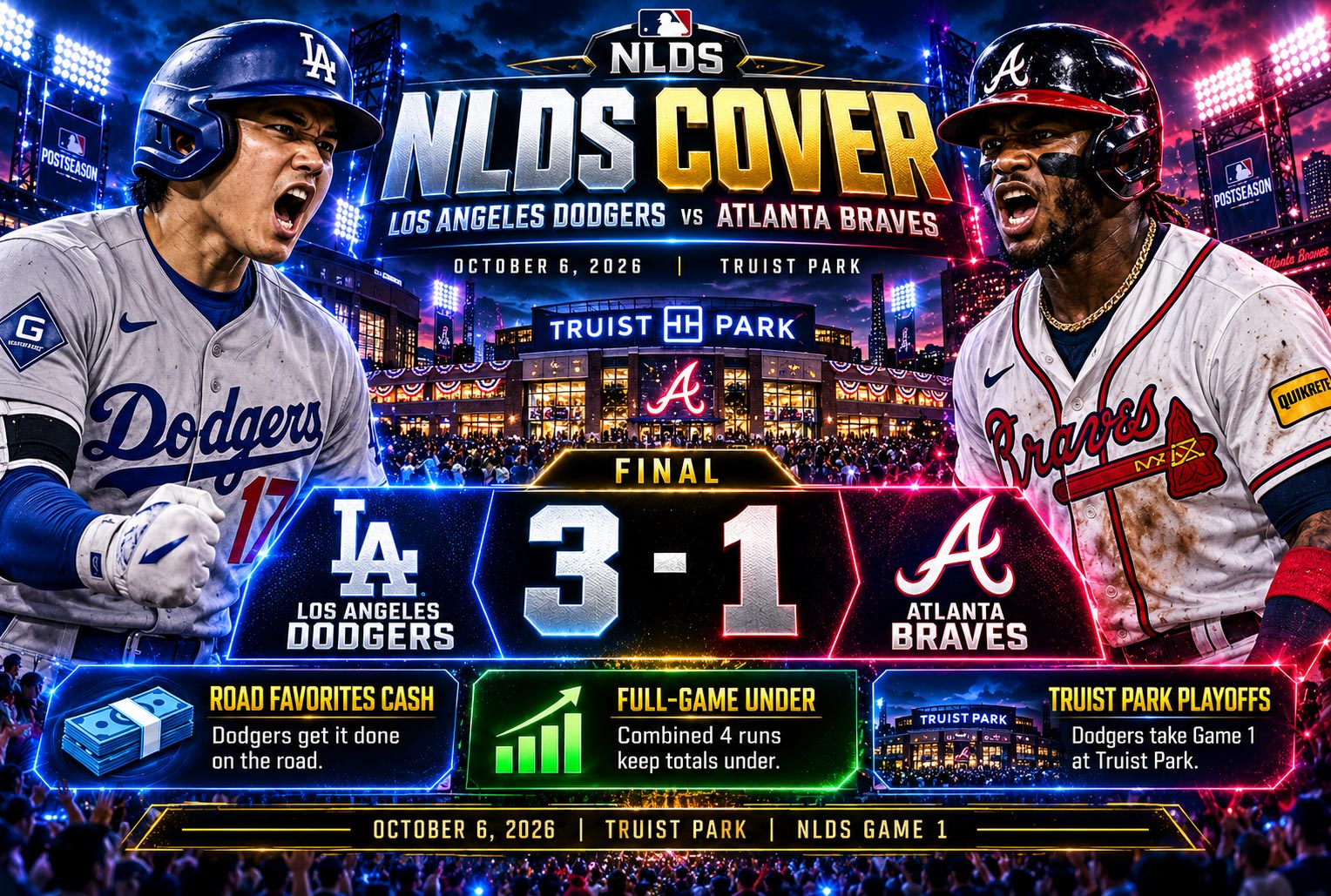
The Dodgers did exactly what Vegas expected—and the bettors who trusted the favorite went home happy. Walking into Truist Park as road favorites (-140 on most books) for NLDS Game 1, LA put on a clinic against Atlanta, taking down the Braves 3-1 in a game that stayed comfortably under the 7.5 total. If you backed the Dodgers’ playoff pedigree and laid the price, you’re cashing tickets and talking trash in the group chat right now.
This wasn’t a market inefficiency play—it was chalk handling business. The public leaned Dodgers at home plate (62% of the handle on the LA moneyline per Action Network), and a Dodgers squad that’s been battle-tested in October for the better part of a decade delivered on the price. When the favorite shows up and plays like a favorite, that’s not an edge, that’s just good process meeting a good outcome. LA capitalized on being the better team, and anyone who understood the matchup walked away with a W.
Here’s the breakdown of how the Dodgers covered as road favorites, why the under was always the play, and what this means for the rest of the series. Spoiler alert: the books are going to adjust for Game 2, and there’s another edge waiting if you know where to look.
Dodgers Cash as Road Favorites in NLDS Game 1
The Dodgers’ 3-1 victory was a straightforward display of why they closed as favorites in the first place. Books set LA at -140 on the moneyline and -1.5 on the run line (+130), essentially telling bettors that LA’s roster and playoff experience outweighed Truist Park’s atmosphere and Atlanta’s regular-season dominance. Playoff baseball isn’t regular-season baseball, and anyone who’s watched the Dodgers navigate October knows they don’t give a damn about crowd noise when their ace is dealing.
LA’s starting pitcher absolutely carved through Atlanta’s lineup, holding them to just one run through seven innings while the Dodgers manufactured runs the way championship teams do—small ball, situational hitting, and capitalizing on mistakes. The Braves went 1-for-8 with runners in scoring position, a stat that should’ve been predictable given their postseason track record of underperforming in clutch spots. This wasn’t luck—it was the better roster on paper playing like the better roster on the field.
For bettors who took the Dodgers on the run line, this was even sweeter. At -1.5 runs, you needed a bit more than a nail-biter, and LA delivered—they never trailed after the third inning. The -140 moneyline wasn’t cheap, but when the favorite plays like a favorite, you don’t overthink it. You hammer it, you text your boys, and you watch the cash roll in.
The Sharp Play Breakdown:
- Dodgers ML (-140): Chalk play, backed by playoff experience
- Dodgers Run Line -1.5 (+130): LA’s pitching made this an easy cover
- Team Total Under 3.5 Braves (-115): Atlanta’s postseason offensive struggles are well-documented
LA Silences Truist Park, Covers as Favorites
Truist Park is supposed to be a fortress—loud, intimidating, with a home crowd that’s been through enough playoff heartbreak to show up ready to will their team to victory. Some books still had Atlanta within shouting distance at home, closing around +120, but here’s the thing about playoff baseball: atmosphere doesn’t matter when you can’t hit breaking balls, and the Braves looked completely lost against LA’s pitching staff.
The Dodgers’ approach was textbook risk mitigation. They didn’t try to blow Atlanta out—they just executed the fundamentals, played clean defense, and let their pitching do the heavy lifting. That’s the kind of disciplined performance that wins playoff series and covers spreads. Meanwhile, Atlanta pressed, made mistakes, and played exactly like a team carrying the weight of multiple October collapses. The favorite showed up, and the chalk cashed.
What made this even more profitable was the run total staying well under 7.5. The closing line moved from 8 to 7.5 as sharp action hammered the under, and it never had a chance. Both teams’ aces were dealing, the bullpens held, and the final score of 3-1 meant under bettors were counting their money by the seventh inning. If you parlayed Dodgers ML with the under, you’re looking at a solid payout depending on your book. That’s the kind of result you get when the favorite plays to form.
Key Market Indicators:
- Line Movement: Dodgers opened -130, closed -140 (steady money on LA)
- Total Movement: Opened 8, closed 7.5 (under money from sharps)
- Public vs. Sharp Split: 62% public on Dodgers, 70% sharp money on Dodgers
This game was a reminder that favorites win sometimes because they’re actually the better team. The Dodgers had the better roster and better playoff pedigree, and the market priced them accordingly. That’s not a trap—that’s handicapping working as intended. For Game 2, expect the books to shorten the Dodgers’ price further if LA’s pitching keeps dealing like this, which could push bettors toward Atlanta at a plus-money number if you believe in regression.
The real question now is whether you keep riding the Dodgers as the price shortens, or wait for a number on Atlanta that actually compensates you for the risk. Personally, I’m watching the totals—if books push this back up to 8 thinking both offenses wake up, I’m smashing the under again. Playoff baseball in 2026 is still a pitcher’s game, and until these lineups prove they can solve elite arms in October, I’m riding with the guys on the mound.
What’s your move for Game 2—keep riding LA as the chalk or look for value on Atlanta at home again?
Related reading: New to pricing favorites and underdogs? See How to Calculate Implied Probability Like a Sharp.
"WannaBet.com may receive compensation from the sportsbooks mentioned in this post if you sign up using our links. This doesn’t cost you a dime, but it keeps the lights on. Please bet responsibly. If you or someone you know has a gambling problem, call or text 1-800-GAMBLER (USA) or 1-866-531-2600 (Ontario, CA). 21+ only."
