

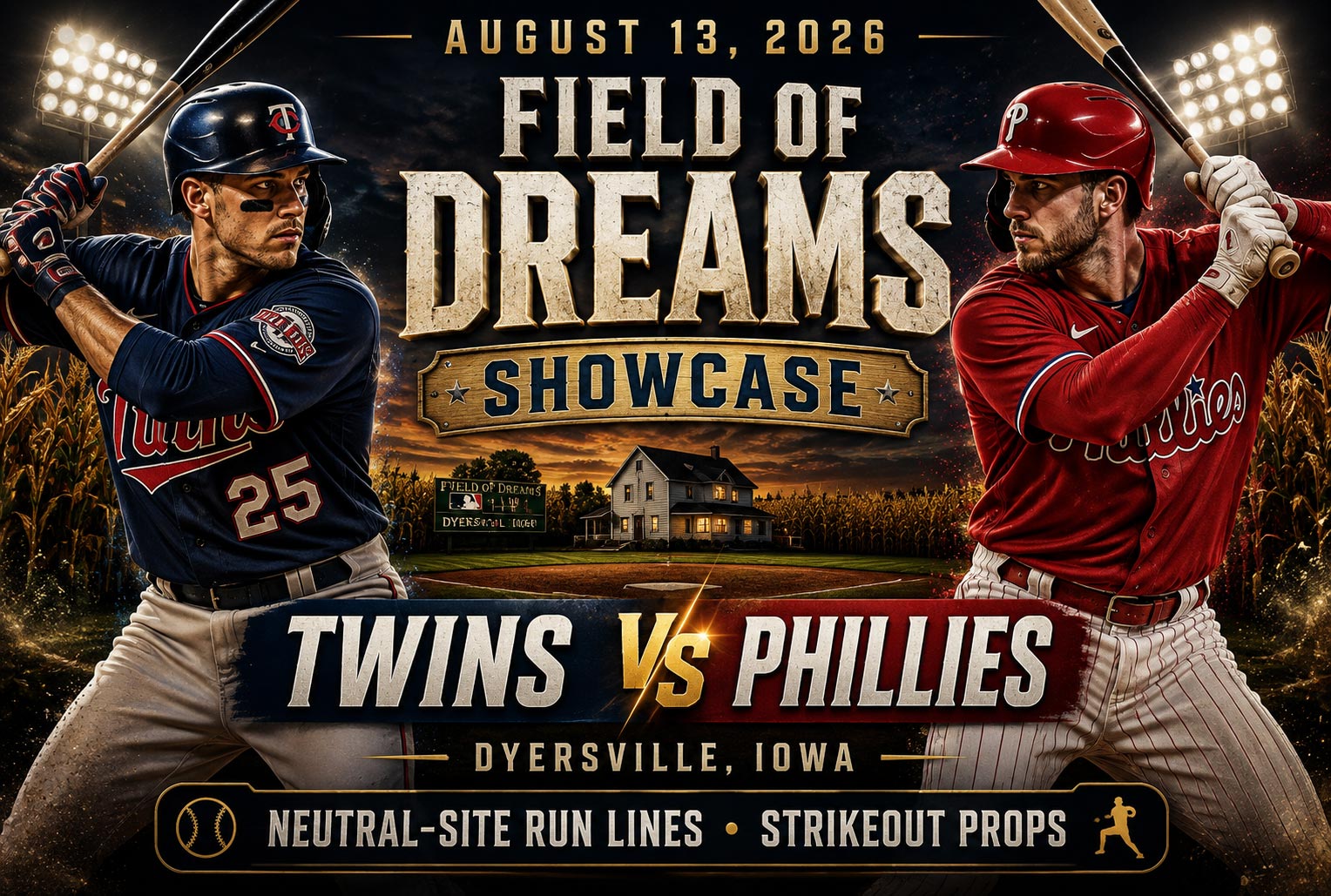
Baseball’s most iconic alternate-site game is back, and this time the Minnesota Twins are squaring off against the Philadelphia Phillies in the middle of an Iowa cornfield on August 13, 2026. The Field of Dreams game has become appointment viewing since its 2021 debut, and sportsbooks are already cooking up lines that deserve serious scrutiny. This isn’t your standard Wednesday night matchup—we’re talking neutral site dynamics, potential lineup changes for the spectacle, and atmospheric conditions that could turn this into either a pitcher’s duel or an absolute slugfest.
The betting markets for specialty games like this present unique inefficiencies that sharp bettors can exploit. Books are pricing in the nostalgia factor and public sentiment, which means there’s legitimate edge to be found if you’re willing to dig past the Kevin Costner references. Let’s break down the angles that matter and identify where the real value sits for this Dyersville showcase.
2026 Field of Dreams Betting Guide: Twins vs Phillies
The location matters more than casual bettors realize when evaluating this matchup. Dyersville’s temporary ballpark sits in an open field with minimal wind protection, and early August in Iowa can bring humid, heavy air that plays havoc with fly ball carry. Historical weather data from the 2021 and 2022 games showed temperatures in the mid-80s with fluctuating wind patterns—conditions that traditionally favor offense but can be unpredictable enough to make run totals a minefield.
Minnesota comes in as a team built around contact hitting and gap power, which profiles well for a neutral site where familiarity with wall distances goes out the window. The Twins’ lineup construction—assuming health—features multiple switch hitters who can exploit platoon advantages without the home park dimensions they’ve grown accustomed to at Target Field. Meanwhile, Philly brings that Bryce Harper-led thunder that can change a game with one swing, but their strikeout-heavy approach could get exposed if wind conditions make elevation difficult.
The moneyline and run line markets will likely price the Phillies as modest favorites given their brand recognition and recent postseason pedigree. But here’s the thing: neutral site games remove home-field advantage entirely, and the Twins have historically performed well in these showcase environments. I’m watching for any line movement that pushes Philly past -150 on the ML, which would create immediate value on Minnesota as a live dog with comparable talent.
Pitching Matchup Analysis
Neither team has officially announced their starter as of this writing, but let’s game-theory this out. Minnesota will likely tab one of their top-three rotation arms to maximize national TV exposure—think Pablo López or a healthy Sonny Gray type if he’s still in pinstripes. The Phillies counter with their own ace-caliber option, probably someone from their established rotation who can handle the moment. The key here isn’t just who starts, but how managers approach the bullpen in what’s essentially an exhibition with regular-season stakes.
Pitcher strikeout props deserve special attention in this environment. The temporary stadium setup means different sight lines for hitters, and both teams feature lineups that can be exploited with quality breaking stuff. If we get a matchup like a high-spin rate righty against Minnesota’s left-heavy lineup, the over on K props could print. Conversely, Philadelphia’s aggressive approach means they’ll chase—but they also make enough contact to punish mistakes, creating a tightrope for opposing pitchers.
Bullpen usage is where the market inefficiency lives. Managers often treat these showcase games with slightly more conservative pitching changes, wanting to avoid embarrassment on national TV. That means starters might get a longer leash than usual, which directly impacts first five inning (F5) totals and could suppress overall run production if aces are dealing. Monitor the weather reports closely—if wind is blowing out, all bets are off and we’re hammering overs.
Neutral Site Impact on Betting Lines
Books are still figuring out how to price these Field of Dreams games efficiently. The sample size is tiny (only four previous games), but we’ve seen dramatic variance in scoring—from the 2021 Yankees-White Sox thriller that went 9-8 to lower-scoring affairs in subsequent years. The public memory defaults to that first game’s offensive explosion, which means totals might be inflated based on recency bias and nostalgia rather than actual park factors.
The run line becomes particularly interesting in neutral site contexts. Home teams typically have about a 54% win rate in MLB, and the -1.5 run line reflects that edge in pricing. Strip that away, and we’re looking at a more efficient coin flip with adjusted odds. If the Phillies are listed at -1.5 with plus-money odds, that’s a trap—neutral sites historically produce closer games because neither team has the late-inning crowd energy advantage.
Prop markets will be juiced to the gills on star players. Harper, Twins sluggers, whoever’s hot going into August—expect inflated lines on home run props and RBI totals. The sharp play is looking at secondary hitters who benefit from protection in the lineup but don’t carry the public betting weight. Find the number-five or six hitter with favorable platoon matchups and reasonable power metrics—that’s where the EV lives.
Best Bets and Props for Dyersville’s MLB Showcase
The Plays:
-
Minnesota Twins ML (+130 or better): The market will overvalue Philly’s brand. Twins are a competent, well-coached team that doesn’t beat themselves, and at plus-money they represent pure value in a neutral environment.
-
Under Team Total Strikeouts (If Available): Both lineups feature contact-oriented approaches in their middle order. Unless we get max-effort Gerrit Cole types throwing 100 pitches over five innings, strikeout totals tend to run lower in showcase games where pitchers are managed carefully.
-
First Inning No Run Scored (-120 to -140 range): Aces in big moments, unfamiliar surroundings, both teams feeling out the environment—F1 NRSI is a consistent winner in specialty games. The odds won’t be sexy, but it’s a high-probability play for bankroll preservation.
The player prop landscape requires patience until lineups are confirmed 24 hours out. Target guys hitting in the heart of the order who have demonstrated success against the expected pitcher’s arsenal. If Minnesota starts a righty and Harper is locked into the three-hole, his RBI props might actually be underpriced despite public attention—Philly stacks their lineup to get him runners. Conversely, fade home run props on guys who rely on pulling the ball unless wind conditions are confirmed favorable to their power alley.
Total runs is the trickiest bet on the board. Books will likely hang 8.5 or 9, and public money will smash the over based on Field of Dreams mystique. I’m waiting until game day to see actual weather—if we get still air and moderate temps, the under might be the contrarian winner everyone ignores. But if doppler shows 15 mph winds blowing out to center, we’re parlaying overs with reckless abandon.
Advanced Betting Strategies
Risk Mitigation Through Live Betting:
The real alpha in specialty games comes from in-game adjustments. Pre-game markets are inefficient because books lack data, but once the ball’s in play, you can exploit overreactions. If the Twins jump out 3-0 in the first and their ML drops to -200, that’s when you hammer Phillies ML or F5 ML as a middle opportunity. Showcase games produce variance—use it.
Correlation Plays for Parlays:
If you’re building same-game parlays (and you should be, given the juice savings), think about logical correlations. Twins ML + Under correlates if you believe their pitching can neutralize Philly’s offense. Phillies ML + Harper Over 1.5 Total Bases makes sense if you’re riding their star power. Avoid lazy parlays like "Over + Both Teams to Score 4+"—that’s just paying double juice for the same outcome.
Market Shopping Across Books:
This cannot be stressed enough for regulated markets in NY, NJ, PA, IL, OH, and Ontario. Field of Dreams props will vary wildly between books as each tries to balance public action with risk management. DraftKings might hang Harper HR at +320 while FanDuel has +350—that 30-cent difference is massive over a full betting card. Use an odds comparison tool or manually check your top three books before placing action.
Props Worth Targeting
Strikeout Props:
If Minnesota’s starter is a high-K pitcher against Philly’s aggressive lineup, target the over. But be disciplined about the number—anything over 6.5 K in what might be a five-inning start requires near-perfection. I prefer staying under on strikeout totals for showcase games unless there’s a clear velocity mismatch.
Hit Props on Contact Hitters:
Look for guys with low strikeout rates who hit for average. These players thrive in unfamiliar parks because they’re not trying to do too much—they’re just putting the ball in play and letting variance work. A Twins contact hitter at Over 1.5 Hits (+110) against a Phillies starter who gives up hard contact could be the best bet on the board.
Total Bases Instead of Home Runs:
Home run props are lottery tickets. Total bases props offer more paths to victory—a double and a single cashes Over 2.5 TB, while a HR prop requires one specific outcome. Given the uncertainty of how balls will carry in Dyersville’s August air, I’m targeting TB overs on gap hitters who can pepper the outfield rather than swinging for the corn.
The Field of Dreams game is peak MLB theater, but that doesn’t mean we can’t extract value from the betting markets. Focus on the fundamentals—neutral site dynamics remove home edges, weather conditions dictate run environments, and showcase game psychology affects pitcher usage. The public will overbet nostalgia and star power, which creates opportunities for disciplined bettors willing to fade the noise.
Track the weather reports obsessively in the 48 hours before first pitch, wait for confirmed lineups before firing on player props, and don’t be afraid to take unpopular positions if the numbers support it. This game will generate massive handle across every regulated market from New York to Ontario, and where there’s volume, there’s inefficiency.
What’s your early lean—are we trusting the Phillies’ star power or riding with Minnesota as a value dog in the cornfield?
"WannaBet.com may receive compensation from the sportsbooks mentioned in this post if you sign up using our links. This doesn’t cost you a dime, but it keeps the lights on. Please bet responsibly. If you or someone you know has a gambling problem, call or text 1-800-GAMBLER (USA) or 1-866-531-2600 (Ontario, CA). 21+ only."
