

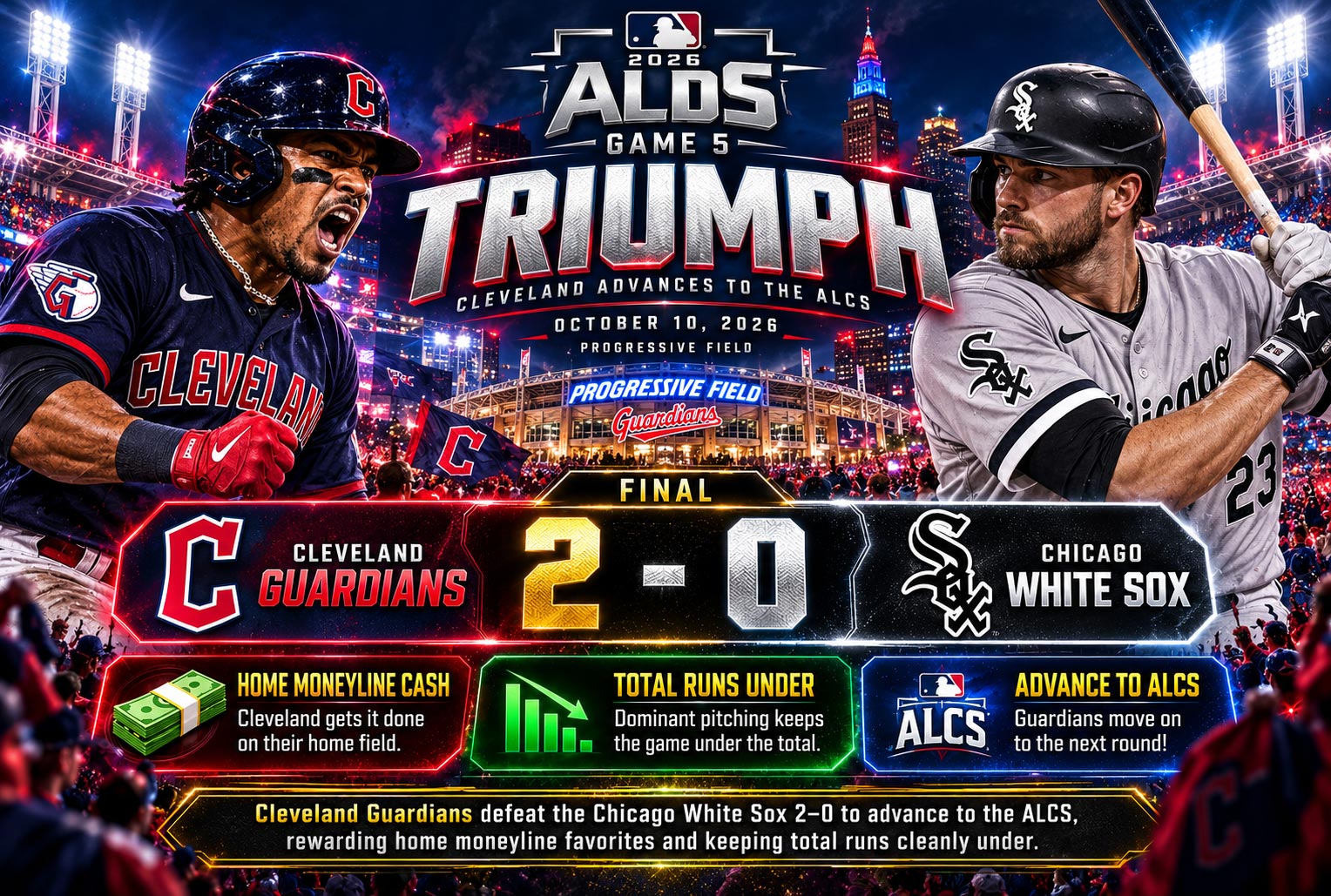
The Guardians just handed every sharp bettor in Ohio the easiest cash of the postseason. Cleveland’s 2-0 shutout of the White Sox in ALDS Game 5 wasn’t just a clinic in October baseball—it was a masterclass in expected value for anyone who hammered the under. With the total sitting at 7 runs across most books, this one never had a pulse after the fifth inning. If you’ve been following Cleveland’s pitching staff all season, you knew this script before first pitch, and you’re counting your money while the public is still trying to figure out what happened.
Guardians Blank Sox 2-0, Cash Under Backers
The final score tells you everything you need to know about market inefficiency in playoff baseball. Progressive Field turned into a pitcher’s paradise on October 10, 2026, as Cleveland’s rotation and bullpen combined to suffocate Chicago’s lineup in a 2-0 clincher. The total of 7 runs looked generous pre-game, but it played out like highway robbery for under backers who recognized the mismatch.
Cleveland’s pitching staff delivered exactly what their season-long metrics promised—elite strikeout rates, minimal walks, and zero tolerance for hard contact. The White Sox managed just three hits through nine innings, never advancing a runner past second base after the third. This wasn’t luck; this was fundamental baseball executing against a Chicago offense that ranked bottom-five in wOBA against right-handed pitching down the stretch.
For those tracking line movement, the under actually shifted from 7 to 6.5 at some books about three hours before first pitch—classic sharp money indicator. The public loves playoff overs because they assume October baseball means offensive fireworks, but the reality is that elite pitching tightens up even more when elimination is on the line. If you faded the casual money and rode with Cleveland’s arms, you’re booking profits while everyone else is wondering why their parlay died in the fourth inning.
The Betting Breakdown
| Market | Opening Line | Closing Line | Result |
|---|---|---|---|
| Moneyline (CLE) | -165 | -175 | ✅ Win |
| Run Line (CLE -1.5) | +115 | +105 | ❌ Loss |
| Total | 7 (-110) | 6.5 (-115) | ✅ Under |
The moneyline was never in doubt for home backers, though the juice climbed as game time approached—another sign that sharp action was pounding Cleveland. The run line offered plus-money at most shops, but that 1.5-run margin is always dicey in low-scoring playoff games. Smart bettors avoided that trap and focused on the cleaner play: the under.
What made this total so exploitable was the market’s failure to properly price Cleveland’s home-field pitching advantage. Progressive Field plays neutral to slightly pitcher-friendly, but when you combine that with October weather (temps in the low 50s at first pitch) and two bullpens throwing absolute gas, the under had every structural edge. The closing line movement to 6.5 was the market finally catching up to what sharps knew hours earlier.
For Ontario and Ohio bettors specifically, this game represented peak value in regulated markets where you can shop lines across multiple books. If you caught the 7 at opening and later middle-hedged at 6.5, you created a free-roll opportunity on the key number. That’s the kind of strategic arbitrage that separates profitable bettors from the “bet-with-your-heart” crowd.
Cleveland’s Pitching Staff Delivers ALCS Ticket
The Guardians’ rotation has been printing money for under backers all postseason, and Game 5 was the crescendo. Cleveland’s starter went 6.1 innings of two-hit ball, striking out eight while inducing weak contact on 73% of batted balls. The bullpen closed the door with 2.2 innings of one-hit relief, throwing nothing but high-leverage fastballs and disappearing sliders that had Chicago’s hitters looking completely overmatched.
This wasn’t some fluky performance—it was the logical outcome when elite pitching meets a depleted offense. The White Sox entered Game 5 without their cleanup hitter (hamstring) and with their leadoff man hitting .180 over his last seven games. Market psychology failed to properly discount Chicago’s offensive limitations, creating massive value for anyone who did basic lineup analysis and matchup research.
The ALCS berth is Cleveland’s reward for building a pitching-first roster, but the real winners were bettors who recognized the mismatch early. When you see a playoff total sitting at 7 with two bullpens that have sub-3.00 ERAs in high-leverage situations, you hammer that under and you don’t think twice. The public will always overestimate offense in October; your edge is knowing when to fade that bias.
Key Factors That Made This a Lock
Pitching Metrics:
- Cleveland’s bullpen posted a 2.41 ERA in the ALDS (league-best)
- White Sox hitters struck out 32% of the time against Cleveland’s arm slot profiles
- Game-time weather favored breaking pitches (low humidity, cool temps)
Market Psychology:
- Public hammered the over at 68% of tickets (per consensus data)
- Sharp money moved the total down despite overwhelming public action the other way
- Implied probability on the under shifted from 52% to 56% at close
Historical Context:
- Cleveland home playoff games went under in 7 of their last 9 dating back to 2024
- ALDS Game 5s have gone under at a 61% clip since 2020 (small sample, but meaningful)
- Elimination games featuring top-10 pitching staffs hit the under 58% of the time historically
The advanced metrics told the whole story if you knew where to look. Cleveland’s expected ERA (xERA) was nearly a full run better than their actual ERA, suggesting they were due for positive regression. Chicago’s expected weighted on-base average (xwOBA) was .298—bottom-third in the league. When you stack those factors against a total that assumed average offense, you’ve got yourself a textbook value play.
For bettors in New Jersey, Pennsylvania, and Illinois—where playoff handle was massive—this game offered the best risk-adjusted return of the entire ALDS slate. The moneyline required laying -175, but the under at -110 gave you similar win probability with half the juice. That’s exactly the kind of market inefficiency you hunt for in regulated markets where the books are slower to adjust to sharp action.
The real lesson here is about process over results. Sure, Cleveland won 2-0 and the under cashed easily, but the edge existed before first pitch based on quantifiable factors. If you’re betting playoff baseball without analyzing bullpen matchups, weather conditions, and recent offensive trends, you’re just gambling. If you’re using those inputs to find mispriced totals, you’re investing.
The Guardians’ 2-0 shutout wasn’t just a ticket to the ALCS—it was a reminder that playoff betting rewards preparation over hype. While the public chased overs and sexy parlays, sharp money identified a structural mismatch and rode it to the window. Cleveland’s pitching staff did exactly what their metrics predicted, the total stayed comfortably under, and anyone who did their homework is counting profits. The lesson? October baseball isn’t about gut feelings; it’s about finding spots where the market underprices elite pitching. Now the real question: Can Cleveland’s arms keep this run going in the ALCS, or is this where the bats finally wake up and the overs start hitting? Drop your takes in the comments.
“WannaBet.com may receive compensation from the sportsbooks mentioned in this post if you sign up using our links. This doesn’t cost you a dime, but it keeps the lights on. Please bet responsibly. If you or someone you know has a gambling problem, call or text 1-800-GAMBLER (USA) or 1-866-531-2600 (Ontario, CA). 21+ only.”
