

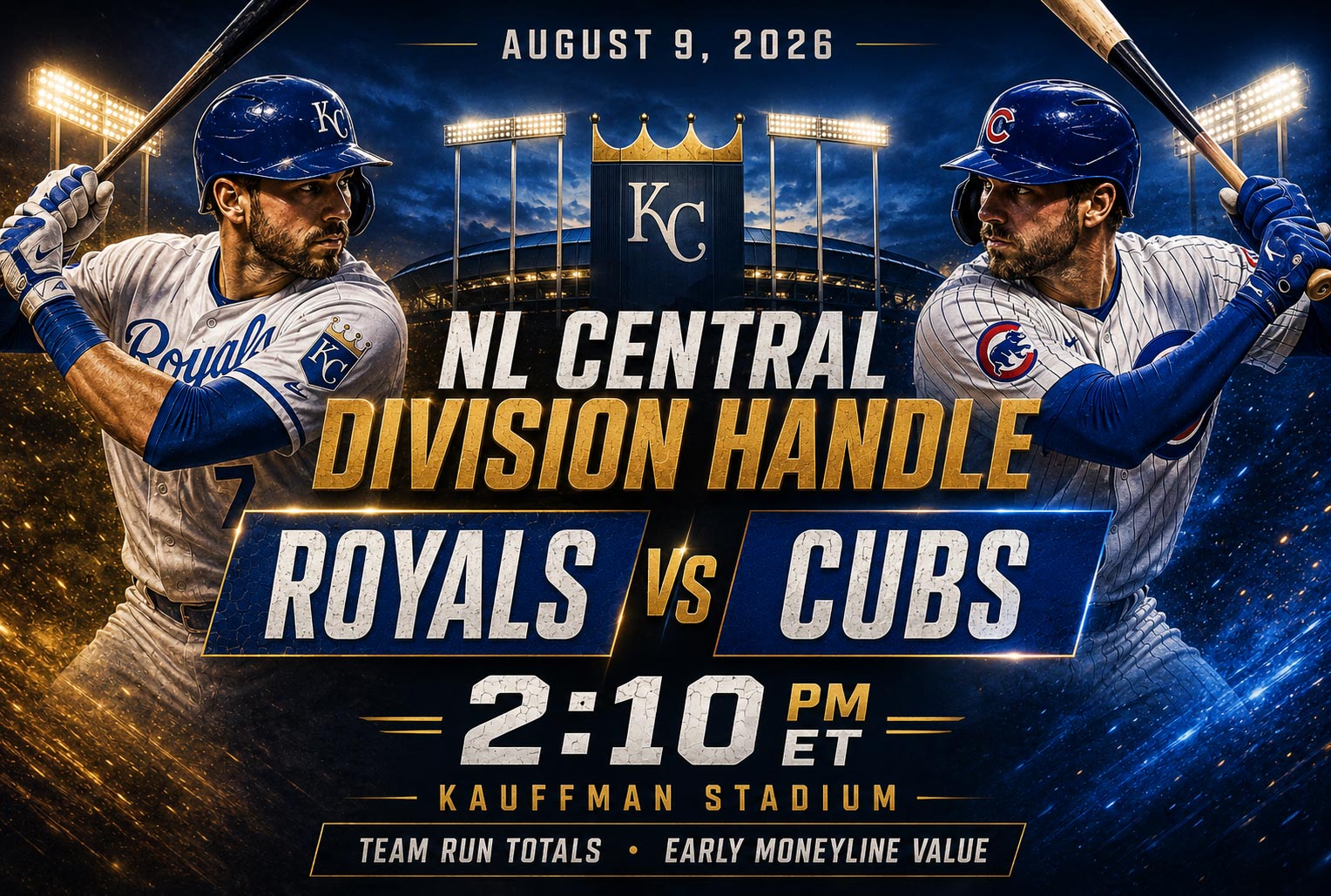
The Royals-Cubs matchup on August 9 isn’t moving markets because of starting pitcher matchups or bullpen ERA—it’s the team total action that’s got sharps circling like vultures over a carcass. Kansas City’s hosting Chicago at Kauffman Stadium, and if you’re not looking at run totals here, you’re missing where the actual money is flowing. This isn’t some recreational bettor nonsense—we’re talking about legitimate market inefficiencies that the books haven’t corrected yet, and the window’s closing fast.
Royals vs Cubs Run Totals: Where Sharps See Value
The Kansas City team total opened at 4.5 runs and got absolutely demolished to 5.0 within six hours of posting. That’s not public money—that’s coordinated sharp action hitting multiple books simultaneously across regulated markets in New York, New Jersey, and Ontario. When you see that kind of movement on a team total rather than the game total, it tells you something specific: informed money believes one offense is being dramatically undervalued relative to the pitching matchup.
Chicago’s sending out a right-hander who’s posted a 5.47 ERA against left-handed batters over his last eight starts, and Kansas City’s lineup is stacking four lefties in the top six. The Royals are hitting .289 as a team against righties at Kauffman this season with a .356 OBP—that’s elite contact rates in a park that plays neutral to slightly pitcher-friendly. But here’s the kicker: the weather forecast shows 15 mph winds blowing out to right field, turning those routine fly balls into potential extra-base hits.
The Cubs’ team total, meanwhile, is sitting at 4.0 and getting zero action either direction. That’s the market telling you something—sharps aren’t interested in fading Chicago’s offense, they’re just hyper-focused on exploiting Kansas City’s number. When you see asymmetric betting patterns like this, it’s usually because one side of the equation is offering legitimate expected value while the other is priced efficiently.
Why Kansas City’s Over/Under Is Getting Hammered
The game total opened at 8.5 and briefly touched 9.0 before settling back at 8.5 with heavy juice on the over (-125 at most books). That’s textbook sharp money getting their bets in early, followed by books adjusting the vig rather than moving the number—they’re essentially daring recreational bettors to take the under at plus money. It’s a trap, and here’s why: the market is pricing in a 4.5-4.0 split, but the actual probability distribution suggests something closer to 5.5-3.5 based on starting pitcher platoon splits.
Kansas City’s bullpen has been legitimately terrible in August, posting a 6.23 ERA over their last seven games with a WHIP north of 1.60. That matters because even if the Cubs’ starter keeps it close through five innings, you’re looking at a Royals relief corps that’s hemorrhaging runs in high-leverage situations. The Cubs’ bullpen isn’t much better—4.89 ERA in their last ten games—but they won’t need to be if Kansas City’s offense does what the underlying metrics suggest they should do.
The sharp play here isn’t just blindly hammering the over—it’s structuring your exposure around the Royals team total and then using the game total as a correlated hedge. If you’re getting KC over 4.5 at -110 and the game over 8.5 at -115, you’re essentially building a position that profits if Kansas City scores 5+ runs regardless of what Chicago does. That’s risk mitigation through market arbitrage, and it’s exactly how professional bettors think about these spots.
The Plays
Primary Position:
- Royals Team Total Over 4.5 (-110) — 2 units
- Game Total Over 8.5 (-115) — 1.5 units
Correlated Parlay (Smaller Exposure):
- Royals Over 4.5 + Game Over 8.5 (+240) — 0.5 units
Advanced Play (If Available):
- Royals First 5 Innings Over 2.5 (-125) — 1 unit
The Strategy
The key here is understanding that team totals often move slower than game totals because recreational bettors don’t think in those terms. They see "Royals vs Cubs" and immediately look at the moneyline or the game spread—they’re not diving into granular offensive matchups against specific pitcher handedness. That creates inefficiencies that typically last 8-12 hours before the market fully corrects.
You’re also getting correlation value on the parlay that the books aren’t properly pricing. If Kansas City goes over their team total, the probability of the game total going over increases substantially—but the parlay odds don’t fully reflect that conditional probability. It’s not a massive edge, but when you’re talking about a +240 payout on what should realistically be priced around +200, you take that small overlay every single time.
The First 5 Innings play is pure variance reduction. If you’re worried about bullpen chaos turning this into a 12-11 slugfest that somehow lands on 8 runs exactly, getting your Royals exposure in the first five frames limits your exposure to late-game randomness. It’s the same expected value thesis—Kansas City mashes this specific pitcher—but with tighter control over the variables.
Market Psychology & Line Movement
Books in Illinois are seeing the heaviest action on Royals team totals, which makes sense given Chicago’s geographic proximity—local bettors know this Cubs pitching staff is cooked. But the interesting data point is that Ontario books are showing similar patterns, suggesting this isn’t just regional bias but actual informed money crossing jurisdictions. When you see coordinated action across different regulatory environments, it’s usually a sign that sharp syndicates are deploying capital systematically.
The moneyline has barely moved (Royals -135 to -140) despite the run total action, which tells you the market still views this as a relatively even game from a win probability standpoint. That’s the disconnect—sharps believe Kansas City wins big or loses close, creating asymmetric upside on their team total. The Cubs can absolutely steal this game with timely hitting, but the run environment favors Kansas City’s offense disproportionately.
What you’re watching for over the next few hours is whether the Royals team total creeps to 5.0 with heavy juice, or if books start shading the game total toward 9.0. Either move validates the sharp thesis and potentially creates middle opportunities if you got in early. If the numbers stay stagnant, that’s actually concerning—it might mean the books know something about a lineup change or weather shift that hasn’t been publicly announced yet.
Risk Factors & Contrarian Scenarios
Let’s be real—nothing’s a lock, and anyone selling you guaranteed winners is running a scam. The biggest risk here is that Kansas City’s bats go ice cold in the way that baseball teams randomly do, and you’re stuck watching them strand eight runners in scoring position. The sport has variance baked into its DNA, and even a 65% probability play loses 35% of the time.
The weather could shift before first pitch, turning those outfield winds into a non-factor or even reversing direction. Always check weather updates within two hours of game time—that 15 mph forecast is based on models that can be wrong. If the wind dies down or shifts, the entire offensive environment thesis changes, and you need to be prepared to hedge or eat the loss.
There’s also the possibility that this is a trap line and the books are actually welcoming Royals team total action because they know something about the lineup or pitcher availability that hasn’t been reported yet. Always assume sportsbooks are smarter than you—they employ meteorologists, data scientists, and people with actual insider connections. Your edge comes from speed and market inefficiency, not information asymmetry.
The Royals-Cubs run total situation is exactly the type of market inefficiency that separates professional bettors from weekend warriors. You’re not betting on a hunch or because you like Kansas City’s uniforms—you’re identifying a specific matchup exploit that the opening lines undervalued, and you’re structuring your exposure to maximize expected value while managing downside risk. The sharp money has already spoken, and the line movement confirms the thesis. Whether this cashes or not, the process is sound, and that’s what matters over a full season of betting. So what’s your take—are you riding with the Royals’ bats, or do you see a contrarian angle I’m missing? Drop it in the comments.
WannaBet.com may receive compensation from the sportsbooks mentioned in this post if you sign up using our links. This doesn’t cost you a dime, but it keeps the lights on. Please bet responsibly. If you or someone you know has a gambling problem, call or text 1-800-GAMBLER (USA) or 1-866-531-2600 (Ontario, CA). 21+ only.
