

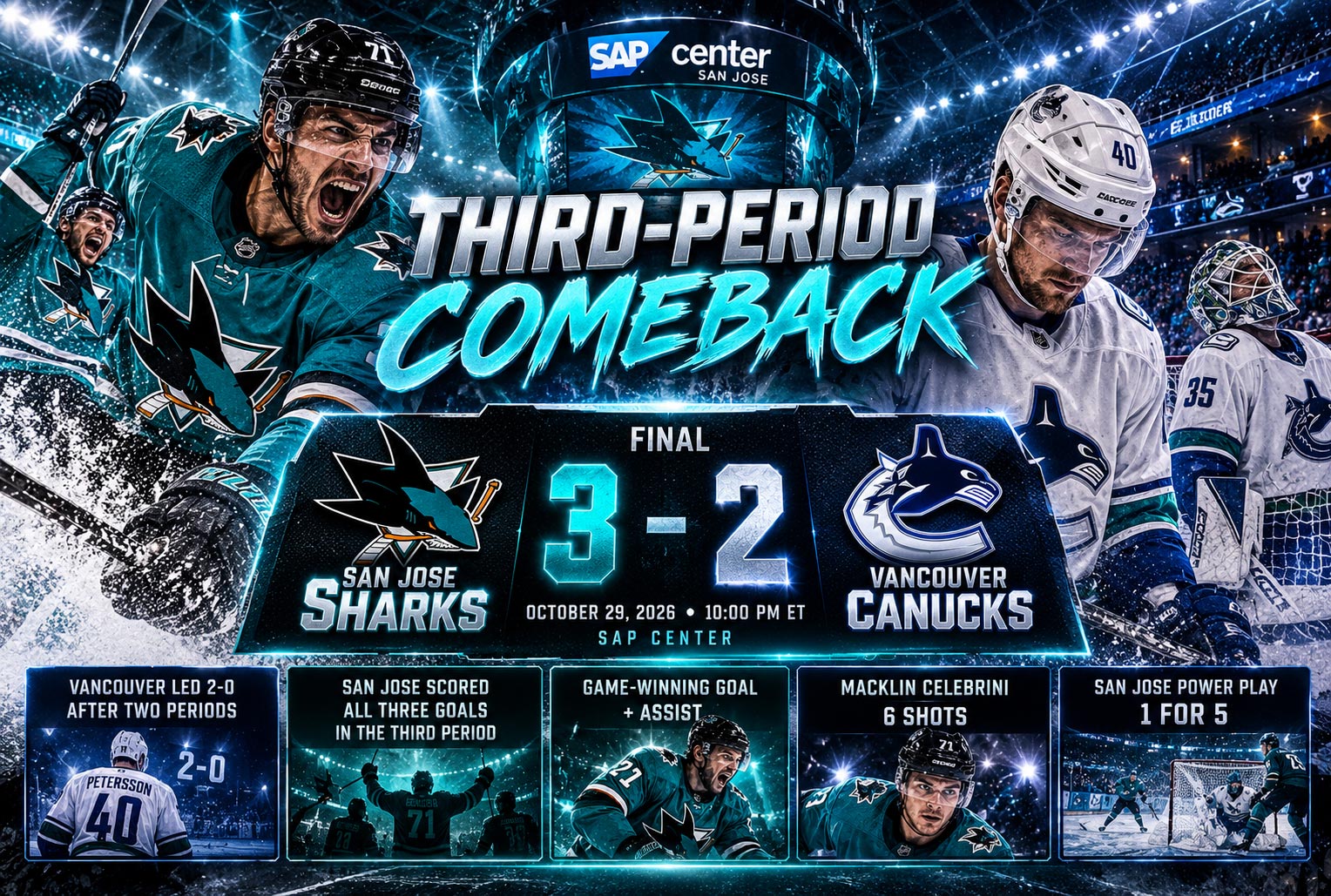
Short version: the Sharks spotted Vancouver a 2-0 lead through 40 minutes, then dumped three goals in the third to steal a 3-2 win at SAP Center on October 29, 2026 — and Mason Marchment’s game-winner torched every Canucks moneyline ticket in the building. If you cashed a live bet on San Jose at second intermission, congrats, you just ran a textbook arbitrage on public panic.
This one had everything degenerates love: a two-goal collapse, a third-period avalanche, a 1-for-5 power play that technically “underperformed” but hit at the only moment that mattered, and a rookie head coach on the losing bench learning that the NHL is a 60-minute league. Let’s break down how the money actually moved — and what it tells us about betting third-period hockey going forward.
Sharks Erase 2-0 Hole, Cash a 3-2 Third-Period Win
Vancouver controlled the first two periods and built a 2-0 cushion, with Liam Ohgren finding the back of the net and Elias Pettersson picking up an assist. At second intermission, the live Canucks moneyline was basically a formality — the kind of number where the juice is so expensive you’re laying a mortgage payment to win a Chipotle bowl. That’s exactly the spot sharp money starts fading, because implied probability on a two-goal NHL lead with 20 to play is always a little fat relative to reality.
Then the third period happened. San Jose scored three unanswered, Mason Marchment delivered the game-winner and tacked on an assist, and Macklin Celebrini chipped in a helper while firing six shots — a volume number that should be tattooed on the forehead of anyone betting SOG props this season. Add assists from Dmitry Orlov and Nolan Allan, and you’ve got a third-period scoring sheet that flipped the entire market in under 20 minutes.
The stat line that matters:
| Metric | San Jose | Vancouver |
|---|---|---|
| Final Score | 3 | 2 |
| Goals through 2 periods | 0 | 2 |
| Third-period goals | 3 | 0 |
| Power play | 1 for 5 | — |
Ryan Warsofsky‘s group didn’t just get lucky — they generated enough looks to make a comeback mathematically live, and the one power play that converted was the difference between a moral victory and an actual one. Five man-advantage chances is a lot of lottery tickets. You only need one to hit.
Why Marchment’s Game-Winner Burned Canucks Bettors
Here’s the brutal math of a live-bet collapse: by the time Vancouver went up 2-0, their live price had compressed to a number where the risk/reward was genuinely terrible, and anyone grabbing it was essentially selling insurance on a volatile asset. One Marchment goal later, that “free money” became a total loss. This is the single most common way recreational bettors blow up bankrolls in hockey — buying into a lead at the exact moment it’s most expensive.
The deeper issue is that NHL leads are not NFL leads. Hockey’s low-event, high-variance structure means a two-goal cushion evaporates way more often than the live market prices in, especially against a team with legitimate top-six firepower. Celebrini putting six pucks on net is the tell: shot volume is a leading indicator, and when a trailing team is generating that kind of pressure, the “safe” side is quietly bleeding equity in real time.
The Strategy going forward:
- Fade compressed live prices. If a team is laying -600 or worse in-game with a full period left, the vig is doing the heavy lifting, not the edge.
- Hunt live dogs with shot-share edges. Trailing teams that are out-attempting the leader are the closest thing to value in live hockey markets.
- Celebrini SOG overs are a standing order. Six shots in a comeback win isn’t a fluke — it’s usage. Shop that number in Ontario books and NJ/PA apps before it adjusts.
- Respect the 5-chance power play. 1-for-5 looks mediocre on paper, but volume of opportunities is the predictive stat, not single-game conversion rate.
Context matters for Vancouver, too. Manny Malhotra is in his first NHL season as a head coach, and his team had just gone to overtime for a wild 6-5 win at Anaheim two nights earlier. Two high-event games in three nights, ending in a road third period, is a situational spot the market routinely underprices — and it’s exactly the kind of schedule-based edge that doesn’t show up in a power rating.
Bottom line: the Sharks’ 3-2 comeback win was a masterclass in why “the game is over” is the most expensive sentence in sports betting. Marchment’s game-winner was the headline, but the real story was Celebrini’s six-shot workload and a San Jose team that kept generating until the math turned.
Going forward, I’m treating San Jose as a live-dog target and Celebrini props as a core weekly position until the books adjust. And if you’re a Canucks backer, maybe pump the brakes on laying heavy chalk with a rookie bench boss until we get a bigger sample on how this group manages third-period leads.
Hot take: two-goal NHL leads should be priced 15-20% cheaper than they currently are, and live-betting hockey leads is the single worst -EV habit in North American sportsbooks right now. Agree, or are you the guy who hammered Vancouver at -700 and is still staring at the ceiling? Drop it in the comments.
“WannaBet.com may receive compensation from the sportsbooks mentioned in this post if you sign up using our links. This doesn’t cost you a dime, but it keeps the lights on. Please bet responsibly. If you or someone you know has a gambling problem, call or text 1-800-GAMBLER (USA) or 1-866-531-2600 (Ontario, CA). 21+ only.”
