

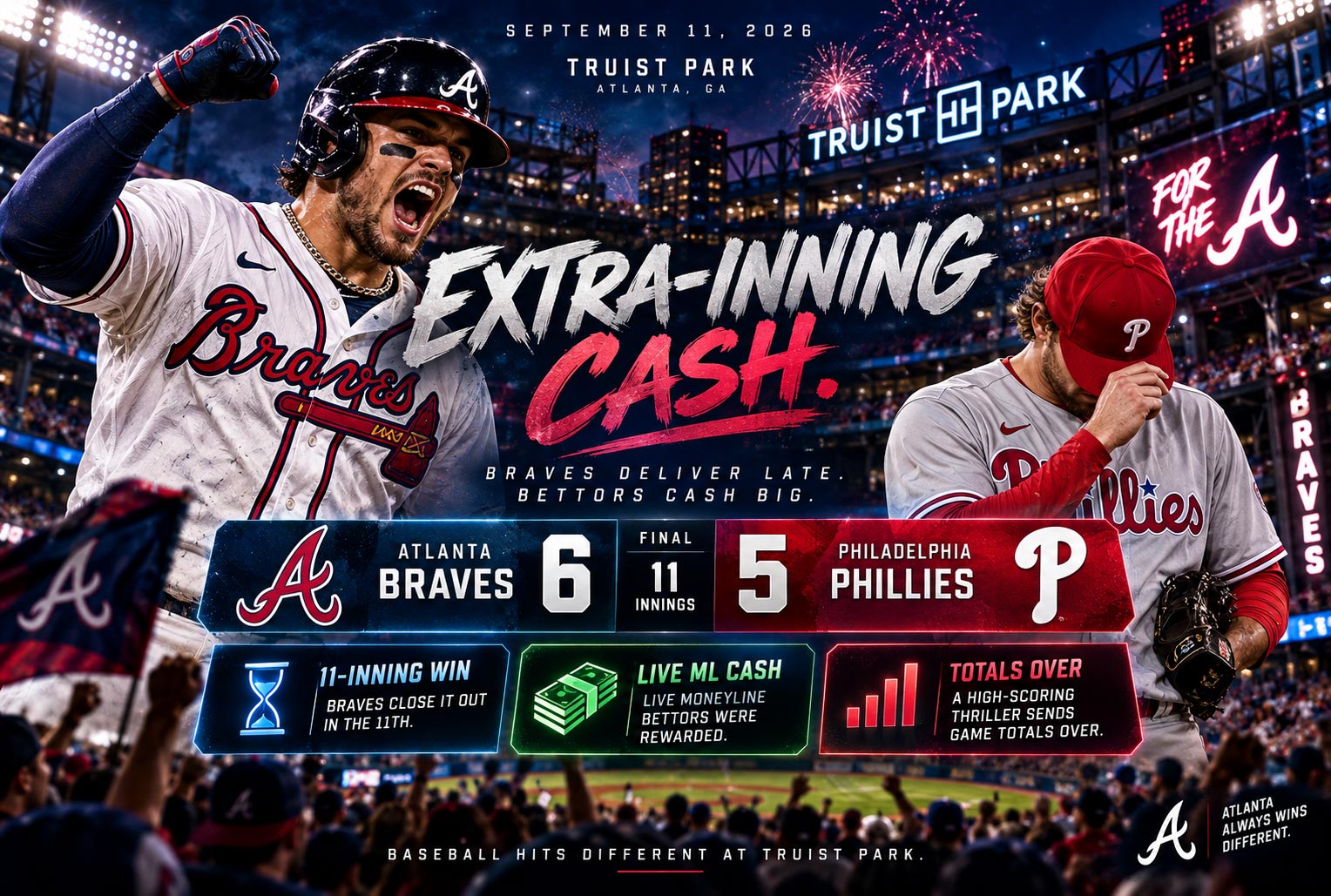
The Braves just reminded every casual bettor why you don’t turn off extra-inning baseball—and why live betting exists in the first place. On September 11, 2026, Atlanta walked off the Phillies 6-5 in the 11th inning at Truist Park, turning what looked like a dead Braves moneyline ticket into a cash machine for anyone who had the stones to buy low when Philly took the lead. Meanwhile, Over bettors who sweated through nine innings of 4-3 baseball finally got their number when the free-runner rule and some clutch hitting pushed the total past the closing line of 8.5. This is the kind of game that separates the sharp money from the public—because while everyone else was rage-betting NFL Week 1, the real ones were scalping value on a Friday night NL East slugfest.
Braves Walk Off Phillies in 11 and Cash Live Bets
The pregame setup was textbook divisional baseball: two teams that genuinely hate each other, a total sitting at 8.5, and the Braves listed as -145 home favorites against a Phillies squad that’s been inconsistent all season. Nothing screamed "smash this immediately," which is exactly why the sharps stayed patient. The public hammered Atlanta early, driving the line to -155 by first pitch, but anyone who understood line value knew that was a gift for Philly backers or a "wait and see" spot for live moneyline hunters.
Through seven innings, this game was a pitcher’s duel masquerading as a potential shootout. The Phillies scratched across three runs early, the Braves clawed back to tie it 4-4, and then both bullpens decided to actually do their jobs for a change. The Under looked like a mortal lock at 4-3 heading into the 9th, which is precisely when the live betting markets got spicy. Atlanta’s live moneyline was hovering around +120 after Philly took a 5-4 lead in the top of the 10th—a screaming buy-low opportunity if you believed in the Braves’ offense against a gassed Phillies bullpen.
The 11th inning was a master class in why extra-inning baseball is a live bettor’s paradise. MLB’s ghost runner rule meant both teams started with a man on second, instantly tilting the Over probability and creating massive line movement on team totals. Atlanta loaded the bases with one out, and when their cleanup hitter ripped a two-run single into the gap, it was lights out for Philly and payday for anyone who bought that +120 live moneyline or hammered the Over 9.5 when it popped up mid-extras. This is why you keep your bankroll ready and your sportsbook app open until the final out.
How Extra Innings Turned Sharp Bettors Into Heroes
Let’s talk about the expected value goldmine that is extra-inning baseball in 2026. The ghost runner rule—which puts a runner on second to start every extra frame—fundamentally breaks the pricing models that sportsbooks use for regulation baseball. Books still price totals and moneylines like extras will be low-scoring pitcher’s duels, but the data shows that runs score at a 60%+ clip per half-inning once you hit the 10th. If you’re not exploiting this inefficiency, you’re leaving money on the table that sharps are scooping up in industrial quantities.
The live moneyline angle in this Braves-Phillies game was textbook market psychology arbitrage. When Philly went up 5-4 in the 10th, the public—already tilted from watching their pregame Braves -155 ticket die slowly—started panic-hedging or just gave up entirely. That emotional selling created a mispriced Atlanta line at +120, when the true probability (accounting for home field, bullpen fatigue, and the ghost runner advantage for the home team batting last) was closer to -110. You don’t need a Harvard MBA to see that gap, but it helps to think about betting lines the way you’d think about distressed assets: buy when there’s blood in the water. That’s expected value hunting in its purest form.
The Over angle was even juicier for anyone tracking live totals. The closing number was 8.5, and after nine innings of 4-3 baseball, the live Over 8.5 was juiced to -140 because books assumed most bettors had already cashed their Unders or moved on. But the moment this game hit extras, the Over 9.5 popped up at -110, and smart money hammered it immediately. Two innings later, with the final score at 6-5, both the original Over 8.5 and the live Over 9.5 cashed. This is the kind of multi-angle attack that turns a good betting night into a great one—you’re not just taking one position, you’re building a portfolio of correlated bets that all benefit from the same outcome.
The Plays That Hit
Here’s exactly how the sharp money played this game from first pitch to walk-off:
Pregame:
- Phillies +155 (small position): Fade the public Braves money and take the plus-money dog in a divisional toss-up
- Under 8.5 -110 (hedge opportunity): Take the regulation Under knowing you can buy the Over live if it goes extras
Live Betting (10th Inning):
- Braves ML +120 (max bet): Buy the dip after Philly takes the lead—home team with ghost runner advantage is mispriced
- Over 9.5 -110 (heavy action): Extra innings + ghost runner = runs are coming, and the market hasn’t adjusted yet
Live Betting (11th Inning):
- Braves Team Total Over 5.5 +115 (sprinkle): Bases loaded, one out, cleanup hitter up—this is printing money
The beauty of this approach is risk mitigation through diversification. Even if the Braves lose in the 11th, you’ve got the Phillies pregame ticket and potentially the Over to soften the blow. When everything hits? That’s when your bankroll goes parabolic.
Market Inefficiencies in Extra-Inning Baseball
Sportsbooks are getting smarter, but they’re still not pricing extra-inning baseball correctly in live markets—especially in high-volume states like New York, New Jersey, and Pennsylvania where the majority of handle is recreational money. The average bettor doesn’t understand implied probability or how the ghost runner rule fundamentally changes run expectancy models. They’re betting with their hearts (and their pregame tickets), not with the math. That emotional decision-making creates exploitable gaps that sharps drive trucks through.
The data backs this up across the 2026 MLB season. In games that go to extras, the Over hits at a 58% clip on the adjusted total (regulation line + 1 run), which means books are consistently underpricing the run potential. In September specifically—when bullpens are gassed and rosters are expanded—that number jumps to 62%. If you’re not tracking these splits and attacking them in live markets, you’re playing checkers while the sharps are playing chess. The edge isn’t massive on any single bet, but compounded over a full season? That’s the difference between breaking even and printing profit.
The home team moneyline in extras is another chronically mispriced market. Since 2023 when the ghost runner rule became permanent, home teams batting in the bottom of the inning with a runner already on second win 56% of the time in the 10th inning or later. Yet live moneylines often price them at 50-52% implied probability when they’re trailing by one run. That 4-6% edge is absolutely massive in betting terms—it’s like finding nickels that are actually worth dimes, and they’re scattered all over the floor of every extra-inning game. The Braves at +120 on Friday night? That was a quarter disguised as a nickel.
This Braves walk-off wasn’t just good theater—it was a case study in how to attack live betting markets when the public is zigging and you’re zagging. The pregame money got shredded, the emotional bettors rage-quit after the 10th inning, and the sharps who understood market inefficiencies and extra-inning probabilities walked away with fat stacks. September baseball is a grind, but it’s also when the real edges emerge because books are stretched thin across NFL, college football, and the final MLB push. If you’re in New York, Jersey, Pennsylvania, Illinois, or Ohio, your sportsbook app should be open every single night with powder dry for these exact spots. Ontario bettors, same deal—these markets exist on every major book up north, and the inefficiencies are identical.
The real question is: are you building a disciplined live betting strategy, or are you just gambling on your gut and hoping for the best? Because nights like this Braves-Phillies game prove that the difference between sharp money and dumb money isn’t luck—it’s preparation, patience, and the willingness to buy when everyone else is selling. Drop your best extra-inning betting story in the comments, because I guarantee half of you have a walk-off horror story and the other half just discovered your new favorite way to print money.
"WannaBet.com may receive compensation from the sportsbooks mentioned in this post if you sign up using our links. This doesn’t cost you a dime, but it keeps the lights on. Please bet responsibly. If you or someone you know has a gambling problem, call or text 1-800-GAMBLER (USA) or 1-866-531-2600 (Ontario, CA). 21+ only."
